
Blog Contested Logistics: Why Distributed, Autonomous Sustainment Wins the Fight
November 2, 2026
Modern naval conflicts require a new approach to moving supplies through hostile waters. When a single supply ship presents a critical vulnerability, distributed unmanned fleets offer a resilient, attrition-tolerant alternative.
Logistics Wins Wars
The ability to supply forces over time decides protracted campaigns. When operating in a contested theater, the supply line itself becomes a primary target. Adversaries recognize that halting the flow of fuel and ammunition is a direct method to halt combat operations.
In previous decades, military logistics relied on the assumption of maritime dominance and secure sea lines of communication. That assumption no longer holds. Planners must assume that every cargo movement will be tracked and potentially intercepted.
Contested logistics is now a named defense priority across military branches. The U.S. Army established a Contested Logistics Cross-Functional Team to address this strategic vulnerability directly.. Core doctrinal texts, including Army Field Manual 4-0 and United States Marine Corps Doctrinal Publication 4, explicitly define the requirement to maintain sustainment under heavy enemy pressure.
The focus of military supply chains has shifted from peacetime efficiency to wartime resilience. Logistics networks must be built to absorb damage and continue functioning.
The Problem: One Big Ship Is One Big Risk
The traditional naval logistics model concentrates cargo onto large auxiliary vessels. These platforms are engineered to move large quantities of material across oceans as efficiently as possible. In a permissive environment with total sea control, this centralized approach makes sense.
In contested space, concentrating supplies creates an obvious vulnerability. A large supply vessel presents a large radar and acoustic signature. It becomes an unmissable, high-value target that an adversary can track from a distance and engage with long-range fires.
Neutralizing a centralized supply vessel inflicts a disproportionate loss. Taking out one hull severs the supply line for an entire theater, starving forward-deployed units of critical material.
Defending these large logistical assets requires pulling advanced surface combatants away from offensive missions to serve in dedicated escort roles. The risk profile of relying on concentrated naval logistics in a contested environment is unsupportable against a peer adversary equipped with advanced anti-ship capabilities.
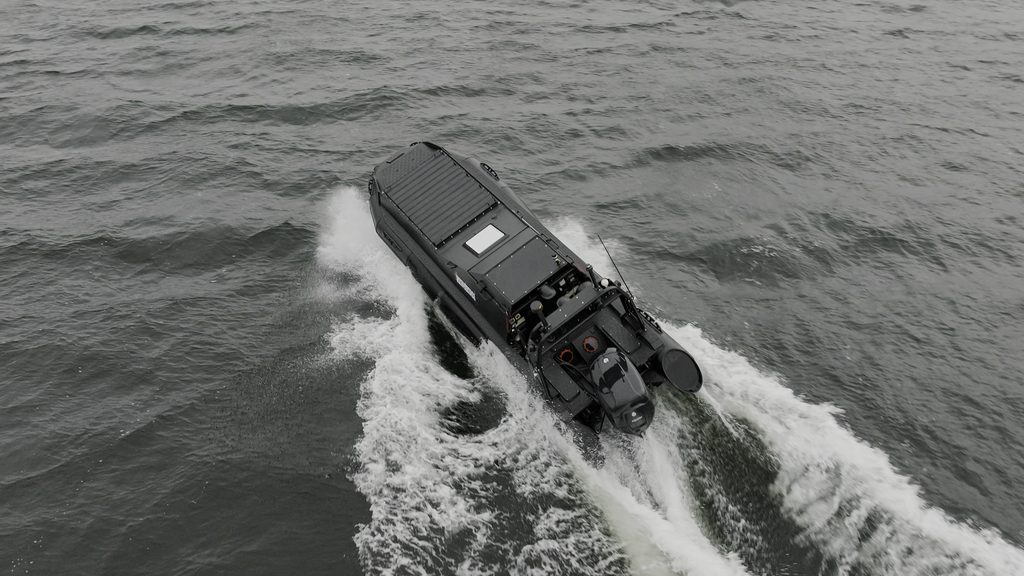
STORMRUNNER, Sea Machines’ purpose-built autonomous USV. Its large payload bay can be configured for resupply missions.
The Shift: Distributed, Attrition-Tolerant Fleets
To maintain sustainment under constant threat, defense planners are moving toward distributed, attrition-tolerant fleets. They are dividing the logistical load across many smaller unmanned surface vessels rather than relying on a single centralized hull.
Each autonomous craft carries a specialized load that varies by vessel type. Payload capacities typically range from a few hundred kilograms for tactical deliveries up to multiple tons or more for sUSVs and mid-sized support craft.
This decentralized approach creates dispersed logistics networks that are difficult for an adversary to detect and target simultaneously. If enemy forces manage to locate and neutralize one autonomous vessel, the network absorbs the isolated loss and the broader resupply mission continues.
This operational concept is moving rapidly from theoretical whitepapers to active procurement. The U.S. Army is currently pursuing a requirement for autonomous resupply vessels designed for operations in the Indo-Pacific theater.
Concurrently, the Defense Innovation Unit ran an Autonomous Resupply Vessel (ARV-S) solicitation targeting containerized payload USV solutions. That specific program demanded autonomous vessels capable of executing routine operations in Sea State 5 and maintaining physical survivability through Sea State 6.
The Doctrine Driving It
This shift toward distributed maritime logistics aligns directly with modern warfighting concepts.
- Distributed Maritime Operations (DMO): Spreading naval forces across wide geographic areas to complicate enemy targeting, as defined in the Congressional Research Service Defense Primer on DMO.
- Expeditionary Advanced Base Operations (EABO) Resupply: Moving small, lethal units rapidly across island chains and austere coastal environments using low-signature delivery methods.
- Agile Combat Employment (ACE): Dispersing forces and logistics networks across multiple austere locations in the Indo-Pacific to increase survivability.
- Manned-Unmanned Teaming (MUM-T): Integrating autonomous logistics platforms directly with human operators to multiply force effectiveness without increasing personnel risk.
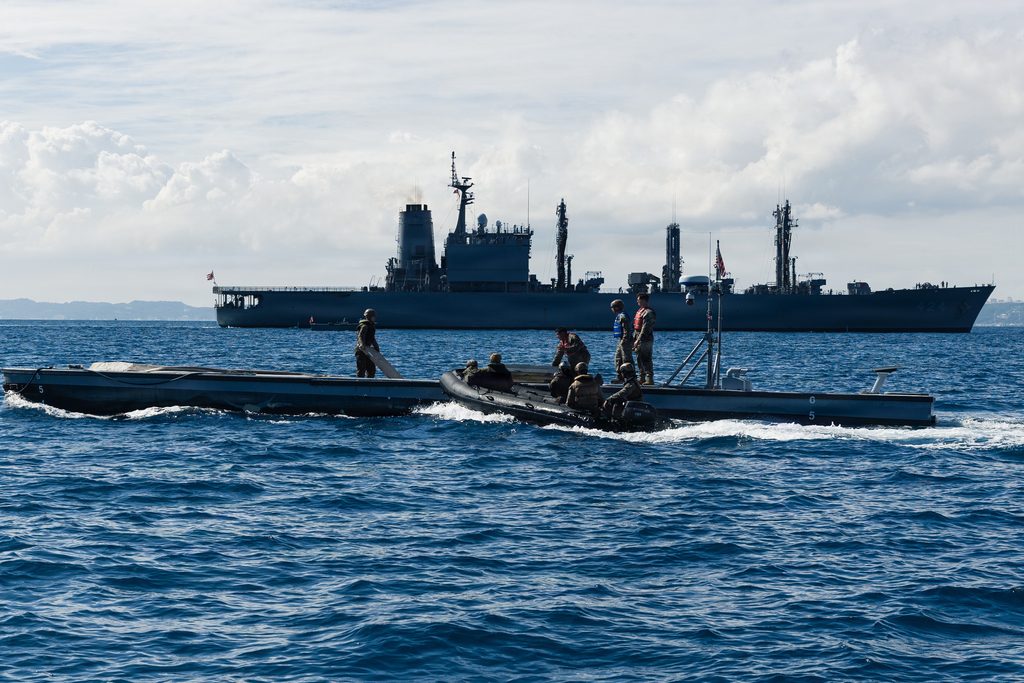
The U.S. Marine Corps’ Autonomous Low-Profile Vessel (ALPV), a 65-foot resupply USV running Sea Machines SM300 autonomy. Photo: Alora Finigan
The Programs Making It Real
The transition to autonomous naval resupply is visible in current acquisition programs.
The Autonomous Low-Profile Vessel (ALPV): Commercially known as Sea Specter, this is a 65 ft. U.S. Marine Corps resupply USV developed by Leidos and Gibbs & Cox. The vessel uses Sea Machines SM300 autonomy to transit endurance waterways and deliver payloads safely to austere locations.
The MUSV Marketplace: Beyond specialized low-profile platforms, the U.S. Navy is scaling its medium unmanned fleet through the Medium Unmanned Surface Vessel (MUSV) Marketplace. Seven companies took part in Phase I at-sea testing. In September 2026, the Navy announced plans to procure 30 MUSVs and accepted the companies that completed Phase I, including Sea Machines, onto the Drones.mil Maritime Marketplace, where they are eligible for follow-on production agreements across the Department of War. Phase II is now underway, opening the marketplace to new entrants and modular payload configurations.
The Containerized Shift: MUSV is built around modular, containerized payloads, so the same class of hull can carry strike, ISR, or cargo missions. For sustainment planners, this means the Navy is designing its medium-USV fleet with transport as a core mission rather than an afterthought.
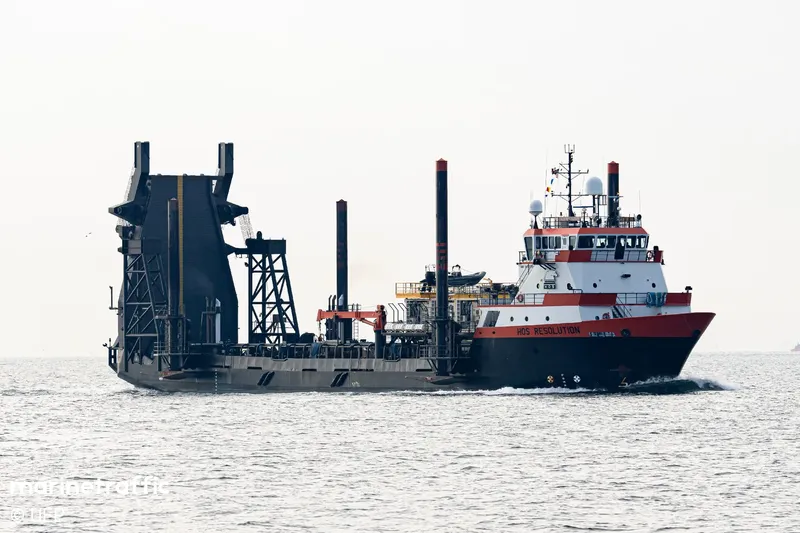
HOS Resolution, a 257-foot commercial offshore supply vessel, carried U.S. Army vehicles during a U.S. Army Pacific experiment in Hawaii. Sea Machines added autonomous navigation and vessel control in nine days.
What Distributed Logistics Demands of the Autonomy
Delivering on the tactical promise of attrition-tolerant sustainment requires specialized autonomy capabilities.
- Force multiplication: One human operator must be able to command and monitor multiple autonomous hulls simultaneously using a fleet command interface like FleetViewer.
- Resilient edge autonomy: Vessels will face intense electronic warfare, requiring edge autonomy that holds steady in GPS-denied and communications-denied conditions.
- Operating as sea states rise: The autonomy must keep operating reliably when maritime conditions deteriorate, matching the ARV-S bar of Sea State 5 routine operations and Sea State 6 survivability.
- Attrition-tolerant economics: The strategy relies on retrofitting the SM300 onto lower-cost available hulls and enabling rapid forward deployment via a Marine Fly-Away Kit (MFAK).
The operational proof of this approach is already fielded, with the SM300 currently operating on the ALPV for USMC resupply. When operational requirements involve maritime traffic rules, the system is designed to support COLREGs compliance, though formal certification remains program and vessel-specific.
Conclusion: The Side That Can Sustain, Wins
In future marine conflict, the side that can sustain its forward forces will dictate the outcome. Distributed autonomous logistics alters the operational math for naval commanders.
It turns the supply line from a fragile single point of failure into a resilient, attrition-tolerant network. By removing human crews from the most dangerous transit routes and using many smaller, autonomous platforms, military forces maintain combat effectiveness under heavy pressure.
Sea Machines provides the field-tested autonomy behind this operational shift. Discuss distributed autonomous sustainment and fleet integration with Sea Machines.
FAQ
What is contested logistics?
Contested logistics refers to the challenge of moving supplies, fuel, and ammunition to military forces while under active enemy threat. Adversaries actively target supply lines to degrade combat effectiveness in modern conflicts. Overcoming this requires resilient supply chains and alternative delivery methods like unmanned systems.
Why distribute cargo across many small USVs instead of one ship?
Concentrating supplies on a single large ship creates one high-value target and a single point of failure. Distributing cargo across multiple unmanned surface vessels creates a dispersed network that is difficult for adversaries to detect and neutralize. If one small vessel is lost, the majority of the payload still reaches the destination.
What is attrition-tolerant sustainment?
Attrition-tolerant sustainment is a logistics strategy that assumes some losses will occur during transit through hostile areas. It relies on using widely available unmanned platforms to move goods. This approach allows military forces to absorb combat losses without catastrophic failure to the overall supply chain.
How do unmanned surface vessels support Distributed Maritime Operations?
Distributed Maritime Operations require forces to operate across vast geographic areas to make enemy targeting harder. Unmanned surface vessels support this doctrine by providing constant, low-signature resupply to these scattered units. They remove human crews from high-threat logistics routes while maintaining the flow of essential materials.