
News SELKIE USV Validated in the West Philippine Sea During Tropical Winter 100
March 17, 2026
Earlier this year, Sea Machines conducted Tropical Winter 100, an autonomy sea trial involving the SELKIE unmanned surface vessel (USV) operating off Subic Bay in the West Philippine Sea.
The mission evaluated autonomous vessel / unmanned vessel operations in the same Indo-Pacific coastal environment where distributed maritime systems could be deployed. The operating area was later used in the distributed maritime autonomy vignette presented during Creative Disruptors in the Desert 2026, where U.S. Congressional and DOW stakeholders observed a mission scenario involving a forward-deployed unmanned surface vessel operating off the Philippine coast.
Strategic Context in the West Philippine Sea
The West Philippine Sea forms part of the South China Sea, one of the most contested maritime regions in the Indo-Pacific. Coast guard patrols, maritime militia activity, and territorial disputes have increased demand for persistent maritime domain awareness across large coastal areas. For the United States and the Philippines, monitoring activity across these waters requires scalable systems capable of maintaining presence without expanding resources for crewed patrol fleets. Autonomous vessels provide a method for increasing range and extending persistent maritime coverage.
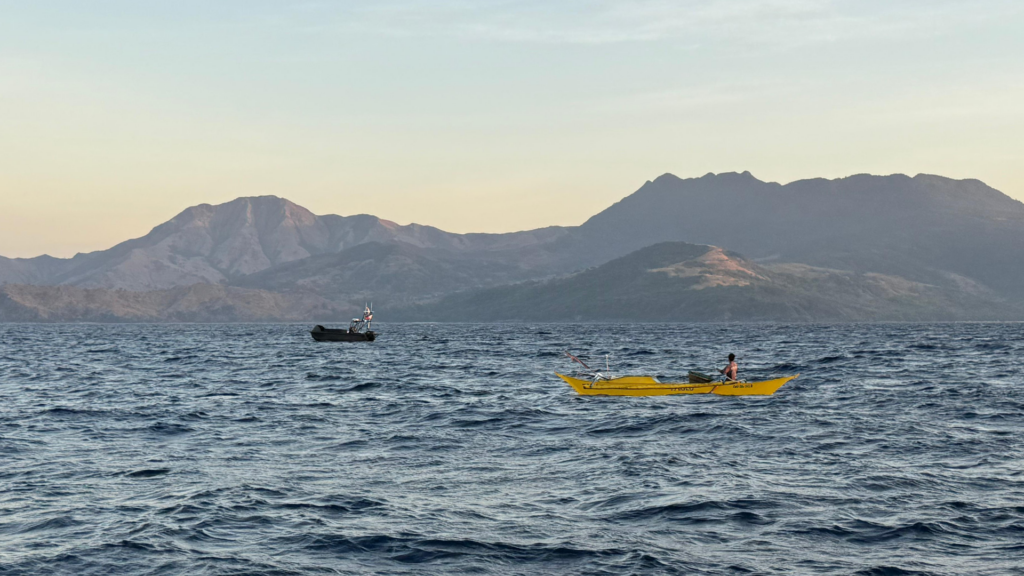
Unmanned Surface Vessel SELKIE operating in real-world maritime traffic off Botolan, Philippines.
Tropical Winter 100 USV Mission
Tropical Winter 100 evaluated SELKIE’s endurance, navigation performance, and autonomous vessel system operation during unmanned operations in Philippine coastal waters.
The mission followed a 100-nautical-mile unmanned route between Subic Bay and the west coast of Botolan. SELKIE departed Subic Bay as an unmanned surface vessel while operators monitored the vessel remotely through the autonomy interface located miles away in Olongapo.
Operating in Sea State 4, the autonomous vessel maintained a cruising speed of approximately 11 knots with sprint speeds of up to 30 knots, and completed the mission over roughly 13 hours. During the voyage the USV executed long range autonomous route following while autonomously tracking and trailing potential vessels of interest, in addition to obstacle detection, and collision avoidance while navigating through typical coastal vessel traffic near the approach to Subic Bay.
USV Operations in the Indo-Pacific
Tropical Winter 100 demonstrated how unmanned surface vessels can operate in real maritime traffic and environmental conditions in the Indo-Pacific. Conducted in the same waters later used during the Creative Disruptors in the Desert vignette, the mission showed how USVs can support persistent maritime domain awareness and distributed maritime operations in regions such as the West Philippine Sea.
What’s Next
SELKIE will continue field demonstrations over the coming months, including integration of mission payloads, effectors, and command-and-control (C2) interfaces across customer use cases. These efforts are focused on expanding operational capability and validating system performance across a broader set of mission profiles.
For organizations evaluating unmanned surface vessel (USV) capability for maritime operations, Sea Machines is engaging with partners to demonstrate how autonomous vessel systems can be applied in operational contexts.
To discuss demonstration opportunities or integration use cases, contact sales@sea-machines.com.